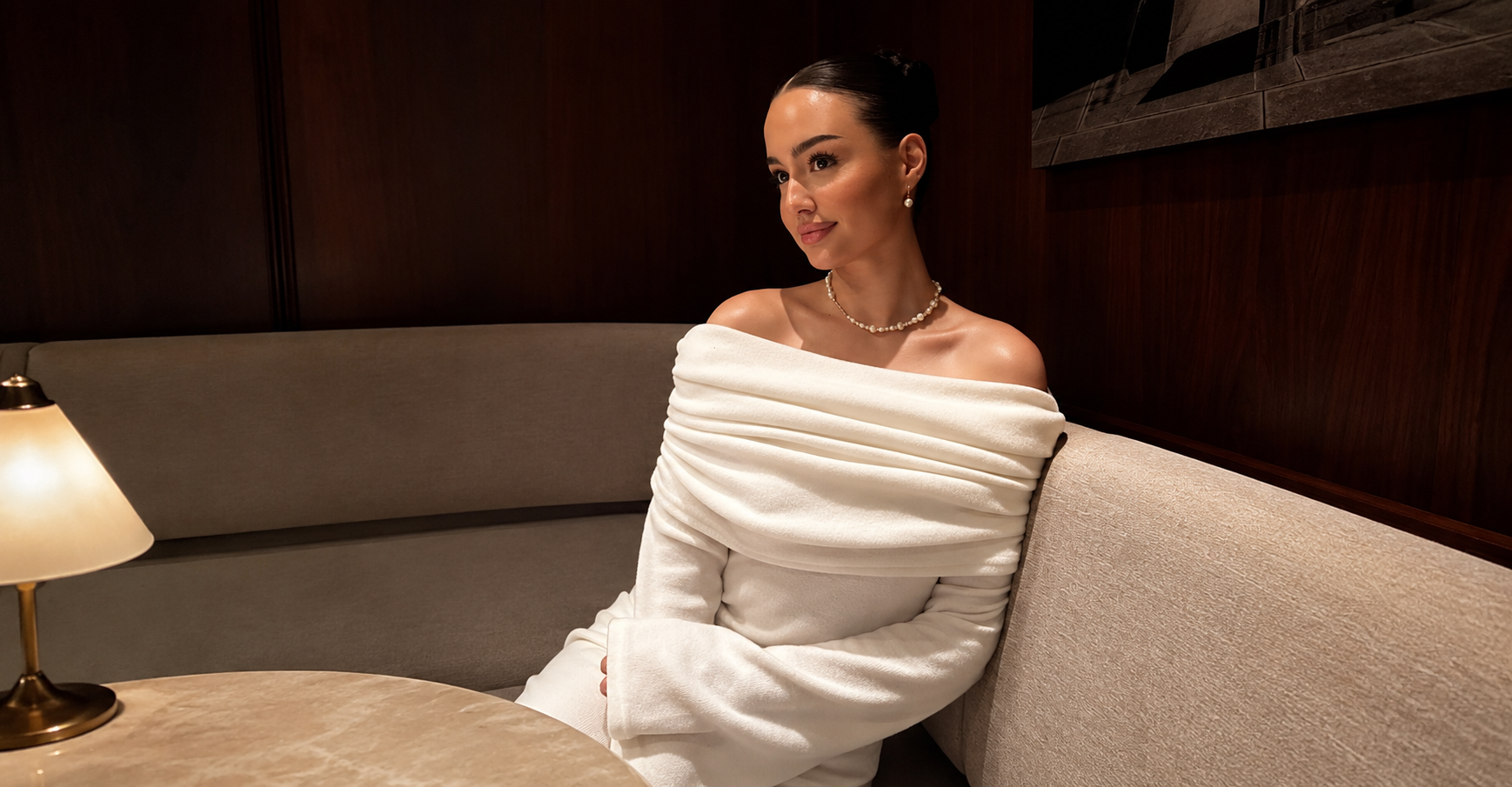
Picture two women getting ready for the same dinner. Same city, same Friday night, roughly the same amount spent on what they’re wearing. One walks in and the room notices, not loudly, not rudely, just the way your eyes follow something that looks right. The other walks in and disappears into the background, not because anything is wrong, exactly, but because nothing quite lands.
Same budget. Completely different energy.
The difference isn’t what they spent. It’s what they understood. One woman got dressed. The other made decisions, and there’s a gap between those two things wide enough to walk a whole wardrobe through.
The Real Reason Some Women Always Look Expensive
We’ve been sold a story about style that keeps us spending and never quite arriving. The story goes: quality costs money, polish requires investment, and looking expensive is simply what happens when you are expensive. It’s a convenient story, for the people selling things. But it falls apart the moment you meet a woman who looks like she just stepped off a runway in something she found on a clearance rail, or the woman in a designer outfit who somehow looks like she’s trying too hard.
Style is a visual language. Like any language, it has grammar, rhythm, and intention. And like any language, you can learn it. Not with money. With attention. The women who always look polished aren’t necessarily spending more. They’ve simply learned to speak the language fluently, and fluency is a skill, not a price point.
The Principles
1. Fit Is the Only Luxury That Matters
There is no silhouette on earth that poverty can’t ruin and that tailoring can’t save. A dress that skims your body exactly where it should, that sits at the right point on your shoulder, that breaks at your ankle with intention, that dress looks expensive. The same dress, one size too large, shapeless across the back, pooling at your feet, looks like an afterthought.
Fit is the foundation of everything. Not colour, not fabric, not trend. Before anything else, a garment has to fit, and most garments, straight off the rack, don’t. They’re made for an averaged-out body that belongs to no one in particular. The woman who looks expensive has usually done something small: taken something in, had a hem adjusted, found the tailor down the road who charges less than a takeaway to make everything look deliberate.
The cost of tailoring a single piece is often less than buying a replacement. But the return, the return is extraordinary. A perfectly fitting garment reads as expensive because it’s the one thing you genuinely can’t fake: it either fits or it doesn’t, and the eye always knows.
2. A Narrow Palette Is a Power Move
Neutrals aren’t boring. They’re the visual equivalent of speaking slowly, everyone pays attention.
The woman who looks expensive has, at some point, stopped chasing color and started curating it. Her wardrobe operates in a family of tones — warm or cool, but consistent. So that everything can be worn with everything else, and every combination reads as considered rather than accidental. This isn’t minimalism for the sake of aesthetics. It’s strategy. When your palette is narrow, you never look like you’re dressed in parts. You look like a whole.
Tonal dressing, wearing different shades of the same color family head to toe, is particularly powerful because it creates a vertical line. It elongates, it unifies, it signals that someone made a decision. And decisions look expensive. Color-blocking in a fragmented palette, on the other hand, can read as chaotic no matter what you paid for each piece individually.
The practical advantage is real, too: a narrow palette means more combinations from fewer pieces, which means you can spend less and have more to work with. The woman who looks rich in six things beats the woman who looks ordinary in sixty.
When your colors agree, your whole outfit stops being an outfit, and starts being a statement.
3. Proportion Is the Silhouette You Wear Before You Get Dressed
Before fabric, before fit, there is proportion, and proportion is decided by how you balance your body. Volume on top demands simplicity on the bottom. A wide leg needs a tucked or fitted waist to anchor it. A long, oversized coat reads as intentional over something sleek; the same coat over bulky layers reads as overwhelmed.
This sounds architectural because it is. You are building a shape every time you get dressed, and that shape either has internal logic or it doesn’t. The women who always look polished have developed an almost instinctive sense of where the weight of an outfit should live. They’re not following rules, they’ve internalized the underlying principle, which is simply this: contrast creates interest, but excess creates chaos.
The most useful habit is standing back and looking at your full silhouette before you leave the house. Not individual pieces, the whole shape. Does it read as one intentional form? Or does it look like several things arguing? When you train yourself to see that distinction, you start making different choices, and those choices compound over time into a look that feels effortless, because it actually is.
4. Grooming Is the Detail Everyone Notices and Nobody Mentions
No one will tell you this to your face, but grooming does more for perceived elegance than most people are willing to admit. It’s not about perfection or maintenance-as-labor. It’s about cohesion. When your hands, hair, skin, and nails look tended to, not necessarily manicured or made-up, but cared for, they send a signal that the rest of you was also thought about.
The woman who looks expensive has usually decided on a grooming aesthetic and stuck to it. Not a complicated one, simplicity almost always reads better than effort, but a consistent one. Her nails are one color or no color, but they’re clean. Her skin is hydrated. Her hair has been given direction, even if that direction is deliberately undone. Nothing is forgotten.
This is where so many almost-polished outfits fall apart: a beautiful look undercut by chipped nails, or unwashed hair that hasn’t quite committed to the undone aesthetic, or ashy hands that tell a different story than the dress. Grooming is continuity. It tells the eye that the whole picture was considered, not just the clothes. Grooming doesn’t have to be expensive. It has to be intentional, and intention is always visible.
5. The Most Expensive Thing You Wear Is How You Move
Expensive-looking isn’t a price point. It’s a posture. It’s the pace at which you walk. It’s having somewhere to be, and knowing it.
The way a woman enters a room, holds her shoulders, meets someone’s eyes, these things shape how everything she’s wearing is perceived. A confident posture doesn’t just improve your mood; it physically changes the drape of your clothes. Shoulders back opens a neckline. A lifted chin elongates the neck. A steady, unhurried walk suggests that you are not chasing anything, and there is nothing that reads more expensive than someone who is not chasing. Also read: 5 Ways How to Be Confident When You Feel Insecure
This isn’t a performance. It’s a practice. You build it gradually: slow down slightly when you walk, let your arms relax rather than crossing them over your chest, take up the space you’re standing in rather than compressing yourself into something smaller. And notice what happens. Not just how you’re perceived, though that changes, but how you feel. There is something about moving through the world as though you belong in it that quietly changes everything else.
6. The Art of the Edit: Remove, Don’t Add
The most common mistake in getting dressed is believing that more is more. Another layer. Another accessory. Another piece to fill a gap that isn’t really there. But the look that reads as expensive is almost always the look that had the courage to stop.
Editing is the hardest style skill to develop because it requires trust. Trust that less is enough. Trust that a clean, simple outfit is stronger than a busy, complicated one. The woman who always looks polished has usually learned to ask not “what can I add?” but “what can I remove?” and the answer is almost always something.
This might be a bag that’s fighting with the outfit instead of completing it. A third layer that’s muddying the silhouette. A necklace that doesn’t need to be there. Jewellery that would look more intentional if it were less of it. The rule is simple, even if the practice isn’t: when in doubt, take one thing off. The outfit that remains is almost always the better one.
Something quietly changes when you stop dressing and start deciding. You walk into a room differently, not because you’re hoping to be noticed, but because you’re no longer worrying about whether you will be. You’ve already done the work before you arrived. The outfit is settled, the silhouette is right, the edit was made, and so your attention is free to go where it belongs: to the conversation, the room, the moment. That is what polished actually feels like. Not admired. Not performing. Just present, with nothing to prove and nowhere to hide, because you never needed to hide in the first place.
And if you’re ready to make this practical, to start tracking your style shifts and refining your personal aesthetic, my Glow Up Journal Planner was designed as a quiet space for exactly that: reflection, intentional habit tracking, and showing up as the most put-together version of yourself, consistently.